
Ten from hundreds: triaging antibody variants with protein language models
A round of antibody optimization rarely lacks ideas. Point mutations, CDR swaps and humanization variants quickly add up to hundreds of candidates.
The bench can express and test a handful.
So the question in every round is not "what could we make?" It is "which ten do we make?"
Most teams answer it with spreadsheets, intuition and structure checks run one sequence at a time. This post walks through answering it with models instead, and how we run that workflow in Novopharos.
hundreds of variants → ten experiments
What does a protein language model know about antibodies?
A protein language model such as ESM-2 is trained to fill in masked amino acids across millions of natural protein sequences (Lin et al., 2023). Along the way it learns which residues tend to appear where.
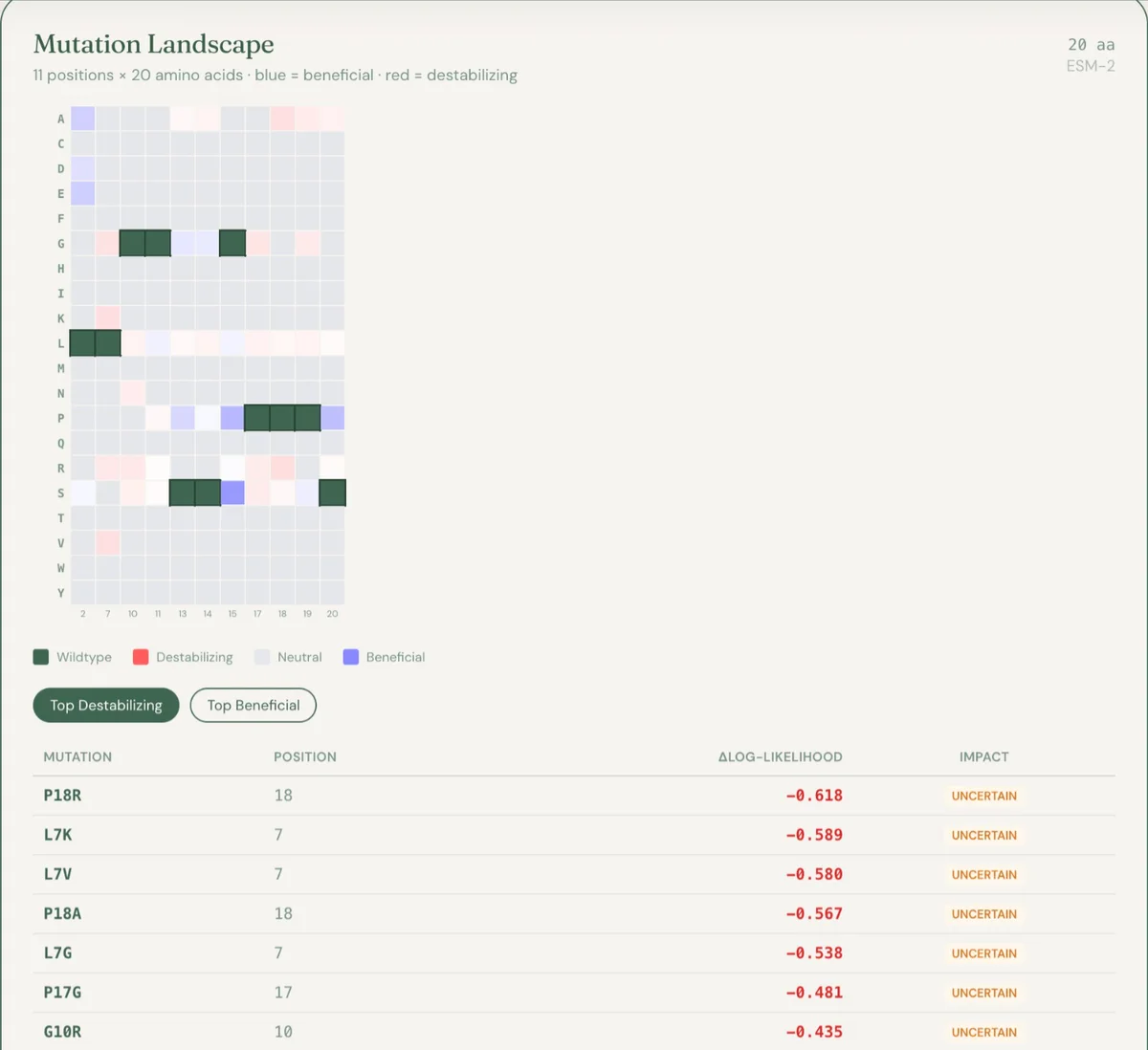
Ask it to score a mutation and it tells you how plausible that substitution looks to evolution, as a change in log-likelihood.
sequence → language model → plausibility of every substitution
That sounds too generic to help with binding. It turns out to help a lot.
Hie et al. (2024) used general protein language models, given no information about the antigen or the structure, to guide affinity maturation of seven human antibodies. Screening 20 or fewer variants per antibody across two rounds, they improved four clinically relevant, highly mature antibodies up to sevenfold and three unmatured antibodies up to 160-fold.
The lesson: substitutions that look evolutionarily plausible are disproportionately likely to keep an antibody folded, expressed and binding.
Why add structure if the sequence model already scores fitness?
Because plausibility is not geometry.
A mutation can look natural and still distort a CDR loop that holds the paratope in place. Structure prediction catches some of that. AlphaFold 3 extended prediction to joint complexes of proteins, nucleic acids and small molecules, with markedly better antibody–antigen accuracy than its predecessor. OpenFold3, an open-source model that aims to reproduce it, was released as a preview under Apache 2.0 in October 2025.
Each prediction comes with per-residue confidence (pLDDT). Low confidence across the CDRs is a reason to look closer before spending bench time, not proof that a variant fails.
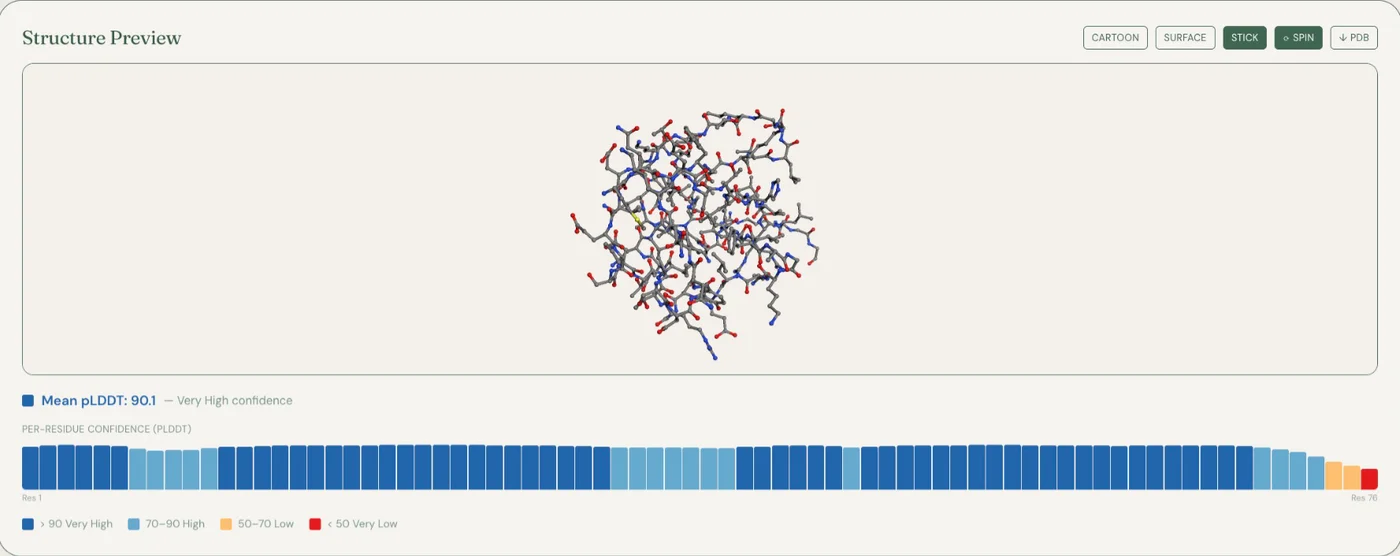
sequence plausibility + structural confidence → fewer surprises at the bench
What about humanness and known liabilities?
A tighter binder that looks foreign to the immune system is not a better drug.
BioPhi (Prihoda et al., 2022) made humanness measurable. Its OASis score, built from 9-mer matches against the Observed Antibody Space, separated human from non-human sequences and correlated with clinical immunogenicity. Its Sapiens model humanized sequences with results comparable to human experts on a 177-antibody benchmark.
In our pipeline, a germline identity filter drops candidates below a threshold the team sets (we start at 85% human germline identity). A literature step then pulls prior art on similar antibodies and known liabilities, so the shortlist arrives with context.
What does the pipeline look like?
Six steps, built in the Novopharos Composer:
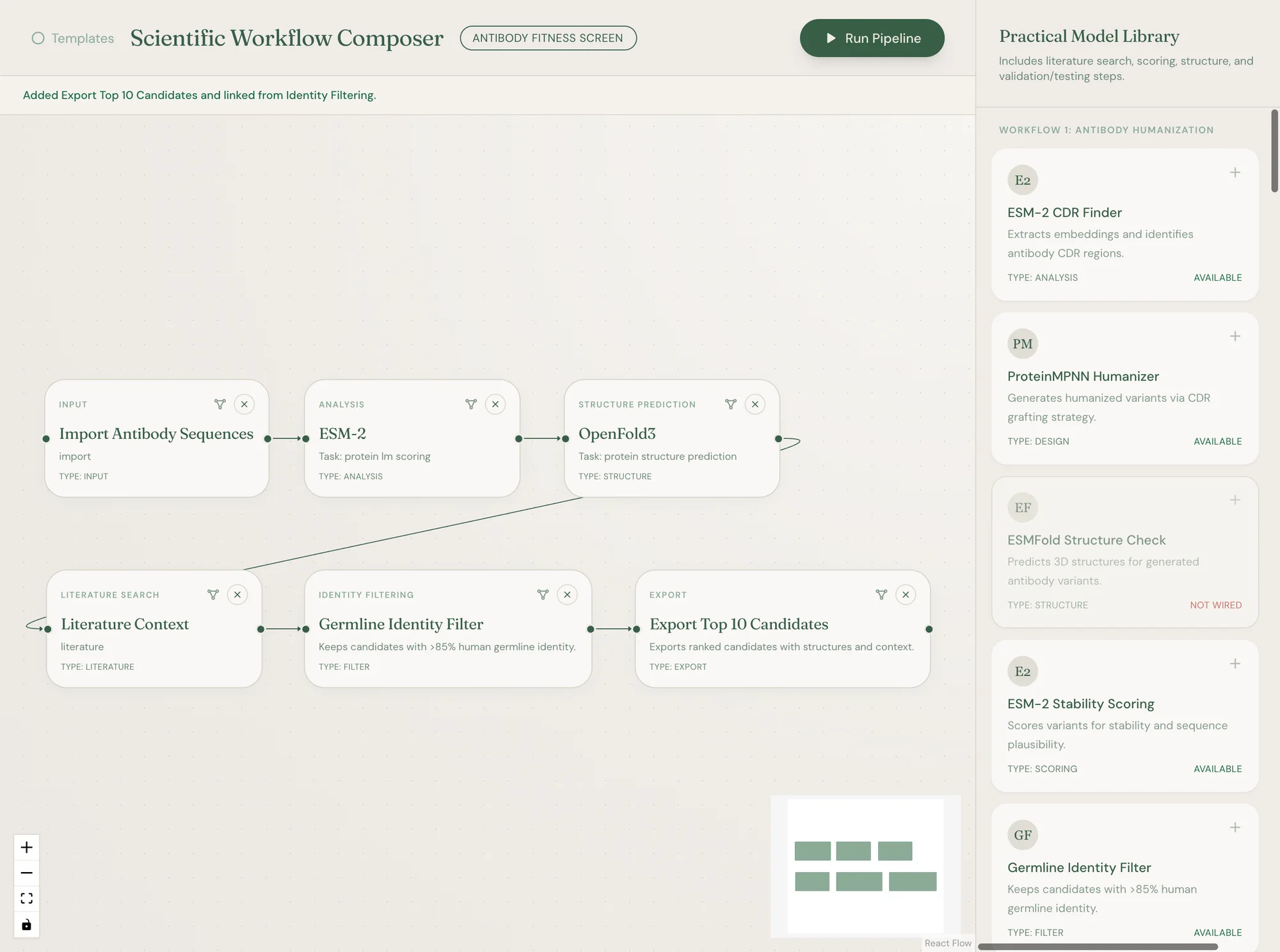
- Import the variant panel, heavy and light chains.
- Score every variant with ESM-2.
- Predict structures and confidence with OpenFold3.
- Pull literature context on similar antibodies.
- Filter on germline identity.
- Export a ranked top 10 with structures and notes.
The same pipeline reruns every round, so the triage logic stops living in one person's spreadsheet.
What's next?
Three open problems are worth being honest about.
Language model scores know nothing about your antigen. Hie et al. showed how far that gets you; specificity still needs binding data or antigen-aware models.
Scores are not calibrated to your assay. Every round of results is a chance to fit the ranking to what your lab actually measures.
Humanness is one developability axis among several. Aggregation, viscosity and expression titer decide just as many programs downstream.
Screen what you can → screen what evolution and structure agree on. The next step is putting your own assay data in the loop.
Sources
- Hie, B.L. et al. Efficient evolution of human antibodies from general protein language models. Nature Biotechnology 42, 275–283 (2024). nature.com
- Lin, Z. et al. Evolutionary-scale prediction of atomic-level protein structure with a language model. Science 379, 1123–1130 (2023). science.org
- Abramson, J. et al. Accurate structure prediction of biomolecular interactions with AlphaFold 3. Nature 630, 493–500 (2024). nature.com
- OpenFold Consortium. OpenFold3 preview, Apache 2.0 (October 2025). github.com
- Prihoda, D. et al. BioPhi: A platform for antibody design, humanization, and humanness evaluation based on natural antibody repertoires and deep learning. mAbs 14, 2020203 (2022). tandfonline.com