
From a VCF to variants you can discuss
A VCF is not a diagnosis. It is a list of differences from the reference genome, most of them harmless.
The work is finding the few that matter, and assembling enough evidence to talk about them.
For missense variants, that work is mostly unfinished. Of the more than 4 million missense variants seen in humans, only about 2% have been annotated as pathogenic or benign by experts (Google DeepMind, 2023).
4 million observed missense variants → about 2% classified
Almost everything else lands in the same bucket: variant of uncertain significance.
What does AlphaMissense actually predict?
AlphaMissense (Cheng et al., 2023) builds on AlphaFold. It was fine-tuned on how often variants appear in human and primate populations, a proxy for what evolution tolerates, then calibrated on known clinical variants.
It scores all 71 million possible single amino-acid substitutions in the human proteome. At a threshold tuned for 90% precision on known disease variants, it classifies 89% of them: 57% likely benign, 32% likely pathogenic.
protein structure + population data → a pathogenicity score for every missense variant
That is a prediction resource, not a diagnosis. Which raises the real question.
How does a prediction become evidence?
Clinical labs classify variants under the ACMG/AMP framework (Richards et al., 2015), which combines evidence into five categories from benign to pathogenic. Computational predictions enter as their own criteria: PP3 when tools support pathogenicity, BP4 when they support benignity.
In 2022, the ClinGen Sequence Variant Interpretation working group calibrated thirteen predictors against independent data sets (Pejaver et al., 2022). They found predictors can provide much stronger evidence than previously thought, at score thresholds specific to each tool.
raw score → calibrated threshold → evidence strength
The practical consequence: any predictor, AlphaMissense included, should be read against thresholds calibrated for clinical use, not reported as a bare number.
Why add a DNA language model?
AlphaMissense only sees amino-acid substitutions. Many variants in a VCF are not missense.
DNA language models read the sequence context directly. DNABERT-2 (Zhou et al., 2024), trained across many species, achieves performance comparable to the previous state of the art with 21× fewer parameters and about 92× less pre-training GPU time. That makes scoring every allele in a VCF practical.
Its scores are a prioritization signal, not calibrated evidence. We use them to decide what a reviewer should look at first.
Where does the literature come in?
Classification often hinges on things no model computes: a functional assay in an old paper, a case report, a segregation study.
A literature step searches for each prioritized gene and variant and attaches what it finds, so a reviewer opens each variant with its evidence already beside it.
What does the pipeline look like?
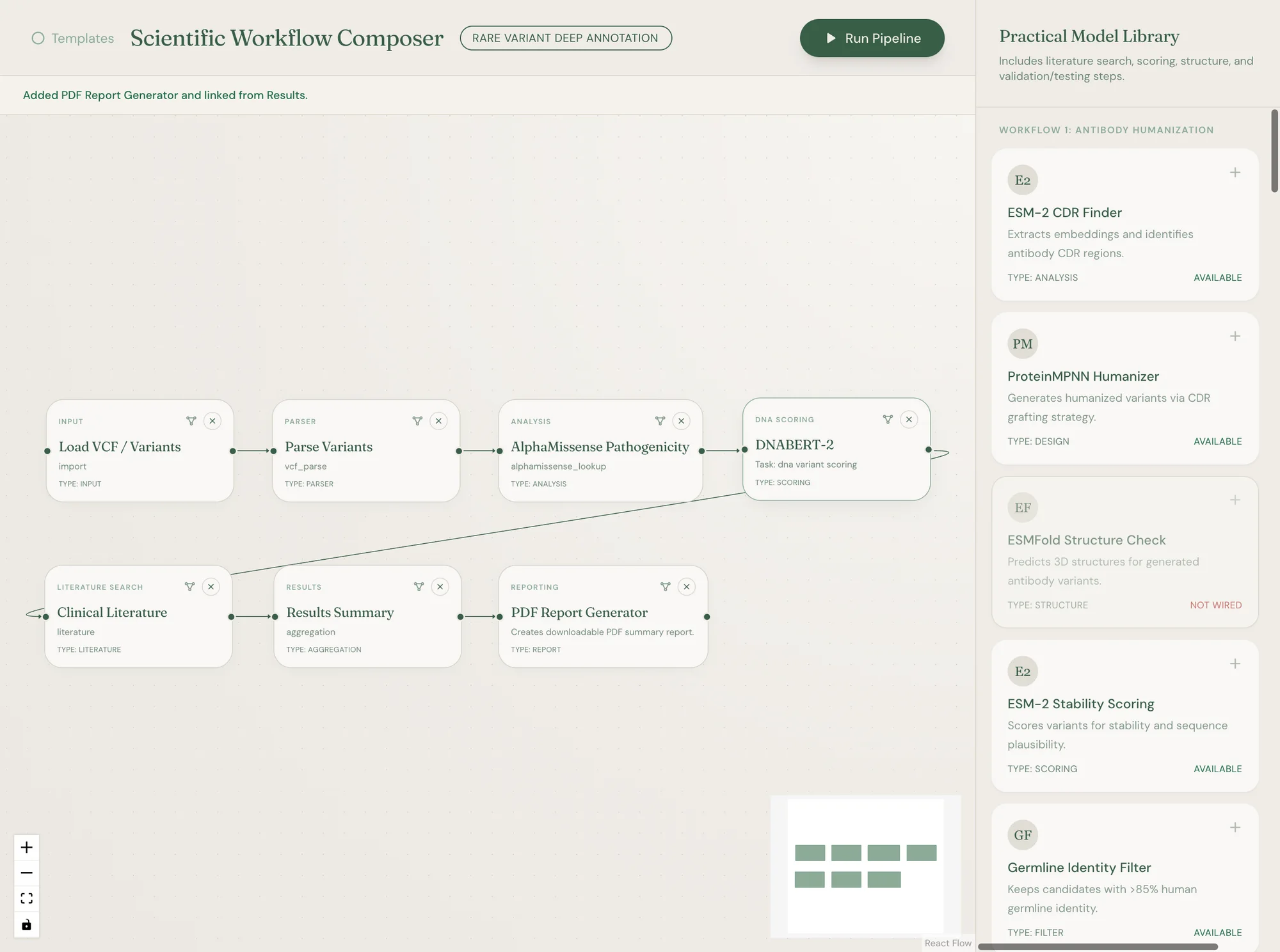
- Load the VCF and parse each variant into gene, position and consequence.
- Look up AlphaMissense scores for every missense variant.
- Score the remaining alleles with DNABERT-2 to decide review order.
- Search the clinical literature for each prioritized gene and variant.
- Summarize scores, thresholds and papers per variant, then render the report.
The output is a ranked table and a PDF the team can review together.
None of it replaces a clinical geneticist's call. It changes how much of their time goes into lookups.
What's next?
Fowler and Rehm (2024) argue that many, if not most, VUS in coding regions will be resolved by 2030. Getting there leaves open questions a pipeline has to respect.
Most of the genome is not coding, and noncoding variants remain much harder to interpret.
Calibration differs by gene and disease, so thresholds need to travel with the scores.
And every model inherits the populations in its training data, which is worth checking before trusting a "likely benign".
Lookups by hand → one pass that attaches evidence to every variant. The next step is the noncoding genome.
Sources
- Google DeepMind. A catalogue of genetic mutations to help pinpoint the cause of diseases (2023). deepmind.google
- Cheng, J. et al. Accurate proteome-wide missense variant effect prediction with AlphaMissense. Science 381, eadg7492 (2023). science.org
- Richards, S. et al. Standards and guidelines for the interpretation of sequence variants: a joint consensus recommendation of the ACMG and AMP. Genetics in Medicine 17, 405–424 (2015). doi.org
- Pejaver, V. et al. Calibration of computational tools for missense variant pathogenicity classification and ClinGen recommendations for PP3/BP4 criteria. American Journal of Human Genetics 109, 2163–2177 (2022). cell.com
- Zhou, Z. et al. DNABERT-2: Efficient foundation model and benchmark for multi-species genomes. ICLR (2024). arxiv.org
- Fowler, D.M. & Rehm, H.L. Will variants of uncertain significance still exist in 2030? American Journal of Human Genetics 111, 5–10 (2024). doi.org