
From target gene to ranked hits, without the glue code
About 90% of drug candidates that enter clinical trials fail. Analyses of trials from 2010 to 2017 attribute 40–50% of those failures to lack of clinical efficacy, 30% to unmanageable toxicity and 10–15% to poor drug-like properties (Sun et al., 2022).
Early computational work cannot fix efficacy on its own. It can make sure toxicity and drug-likeness are weighed long before anyone synthesizes a compound.
The structure-based route to early hits is well known:
gene → structure → pocket → poses → ranked hits
Each arrow is usually a different tool, a different file format and a different person's script.
Where do you dock if there is no crystal structure?
The pipeline starts from a gene symbol. A UniProt lookup pulls the canonical protein sequence, so nobody hand-copies a FASTA file into a web form.
If the target has no crystal structure, you predict one. OpenFold3, an open-source model that aims to reproduce AlphaFold 3, predicts structures of proteins together with small molecules and nucleic acids.
Then you need to know where a ligand could bind. P2Rank (Krivák & Hoksza, 2018) scores points on the protein surface with a machine-learning model and ranks candidate pockets. It outperformed widely used tools such as Fpocket and runs in under a second per protein.
predicted structure → ranked pockets
Pocket choice is a hypothesis, not a fact. When the top-ranked pockets score close together, docking into more than one is cheap compared with betting a campaign on the wrong site.
Can deep learning docking replace the classics?
Partly.
DiffDock (Corso et al., 2023) treats docking as a diffusion process over a ligand's position, orientation and torsions, with no predefined search box. On PDBBind, its top-ranked pose landed within 2 Å of the crystal pose 38% of the time, against 23% for the best traditional method and 20% for earlier deep learning methods.
But RMSD is not the whole story. PoseBusters (Buttenschoen et al., 2024) checked whether predicted poses are physically valid: sensible bond geometry, no clashes with the protein. Deep learning methods often produced implausible poses, and none yet outperformed classical tools such as AutoDock Vina on physical validity or on proteins unlike their training data.
So we use both. DiffDock explores the whole surface. AutoDock Vina re-docks the best candidates in the chosen pocket and scores them with a physics-based function.
explore with diffusion → verify with physics
Why filter for ADMET this early?
Because toxicity alone accounts for roughly 30% of clinical failures, and a predicted liability is cheapest to act on before synthesis.
ADMET-AI (Swanson et al., 2024) predicts absorption, distribution, metabolism, excretion and toxicity properties from a molecule's structure. It holds the highest average rank on the TDC ADMET leaderboard and, run locally, scores a million molecules in about 3.1 hours. That is fast enough to filter every docked hit.
What does the pipeline look like?
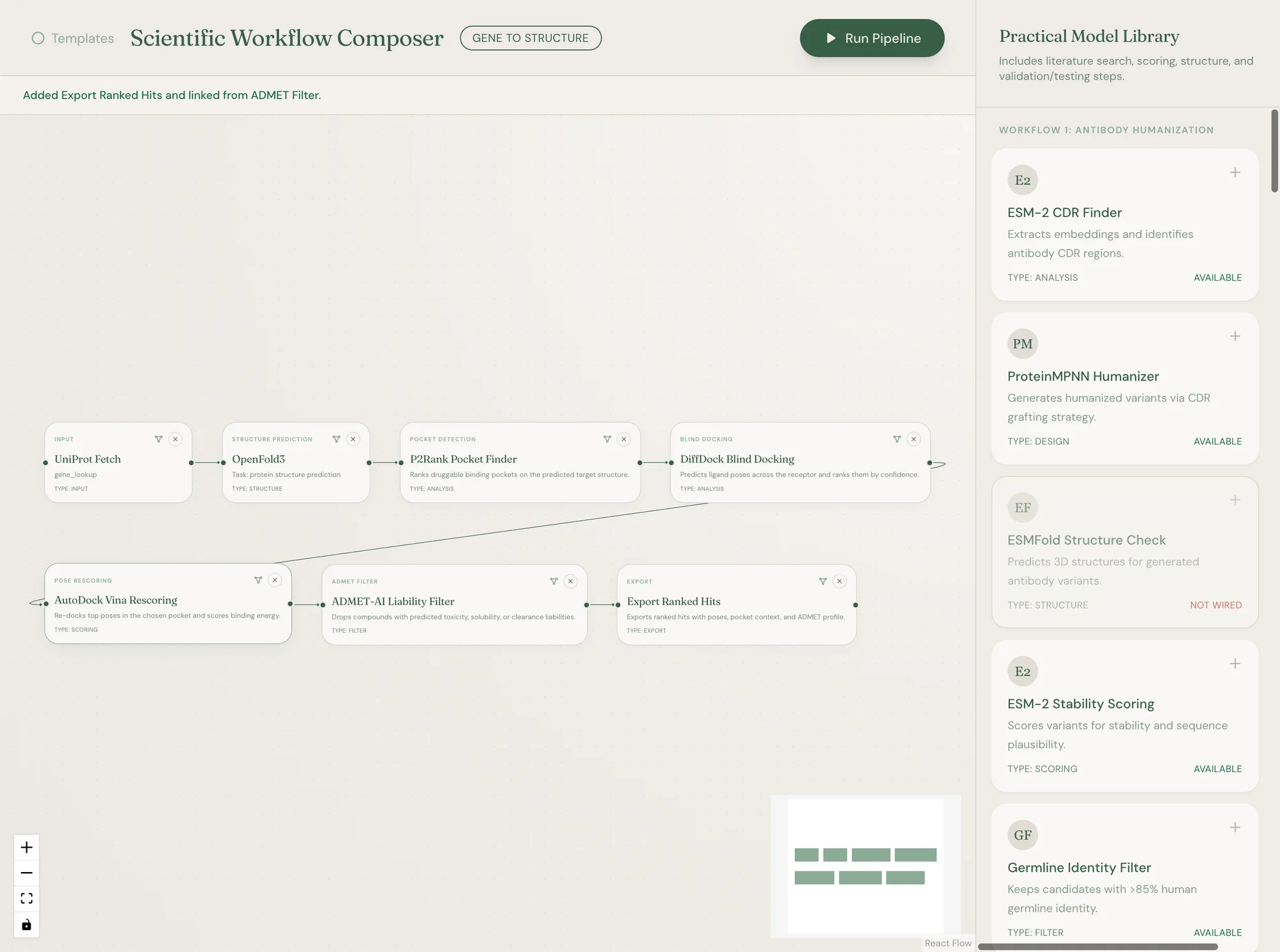
Seven steps on one canvas. The output is a ranked list with poses, pocket context and an ADMET profile for each compound.
It is not an answer. It is a starting point a medicinal chemist can argue with, rerun and improve.
What's next?
Docking scores are not binding affinities. A ranking built on them alone needs experimental follow-up before anyone reads it as potency.
Co-folding models that predict the protein–ligand complex directly, the direction AlphaFold 3 opened, may eventually collapse the structure, pocket and docking steps into one.
And any ranking is only as good as the assay that tests it. The pipeline earns its keep when wet-lab results flow back into the next round.
A chain of tools and file formats → one pipeline your chemists can rerun. The next step is closing the loop with the lab.
Sources
- Sun, D. et al. Why 90% of clinical drug development fails and how to improve it? Acta Pharmaceutica Sinica B 12, 3049–3062 (2022). ncbi.nlm.nih.gov
- Abramson, J. et al. Accurate structure prediction of biomolecular interactions with AlphaFold 3. Nature 630, 493–500 (2024). nature.com
- OpenFold Consortium. OpenFold3 preview, Apache 2.0 (October 2025). github.com
- Krivák, R. & Hoksza, D. P2Rank: machine learning based tool for rapid and accurate prediction of ligand binding sites from protein structure. Journal of Cheminformatics 10, 39 (2018). doi.org
- Corso, G. et al. DiffDock: Diffusion steps, twists, and turns for molecular docking. ICLR (2023). arxiv.org
- Buttenschoen, M., Morris, G.M. & Deane, C.M. PoseBusters: AI-based docking methods fail to generate physically valid poses or generalise to novel sequences. Chemical Science 15, 3130–3139 (2024). doi.org
- Eberhardt, J. et al. AutoDock Vina 1.2.0: New docking methods, expanded force field, and Python bindings. Journal of Chemical Information and Modeling 61, 3891–3898 (2021). doi.org
- Swanson, K. et al. ADMET-AI: a machine learning ADMET platform for evaluation of large-scale chemical libraries. Bioinformatics 40, btae416 (2024). oup.com